


In this guide
- What neighborhoods make up Calabasas?
- How should a buyer new to the area narrow down neighborhoods?
- Why published price ranges for Calabasas neighborhoods are misleading
- Calabasas gated communities, one by one — The Oaks of Calabasas · The Estates at The Oaks · Westridge · Calabasas Park Estates · The Ridge · Calabasas Hills and Calabasas Hills Estates · Mountain View Estates · Mureau Estates · Vista Pointe · Mont Calabasas · Mountain Park · Park South Calabasas · Calabasas Country Estates · Clairidge · Oak Creek Estates · Bellagio · The Colony at Calabasas · Saint Andrews Lane Estates · Country Ridge Estates · Abercrombie Ranch Estates · Creekside · El Encanto · Via Mira Monte · Country Creek Lane · Hidden Hills West
- Calabasas neighborhoods that aren’t gated — Calabasas Lake · Classic Calabasas · Mulwood · Mulholland Heights · Park Moderne · Calabasas Highlands · Deer Springs · Saratoga Hills · Monte Nido
- How do the three Hidden Hills gates differ?
- Which Calabasas neighborhoods do buyers misunderstand?
- Where is the value in Calabasas right now?
- Which Calabasas communities are hardest to buy into?
- What are the downsides of buying in Calabasas and Hidden Hills?
- What actually makes a buyer choose one neighborhood over another?
- Complete roster
- Frequently asked questions
What neighborhoods make up Calabasas?
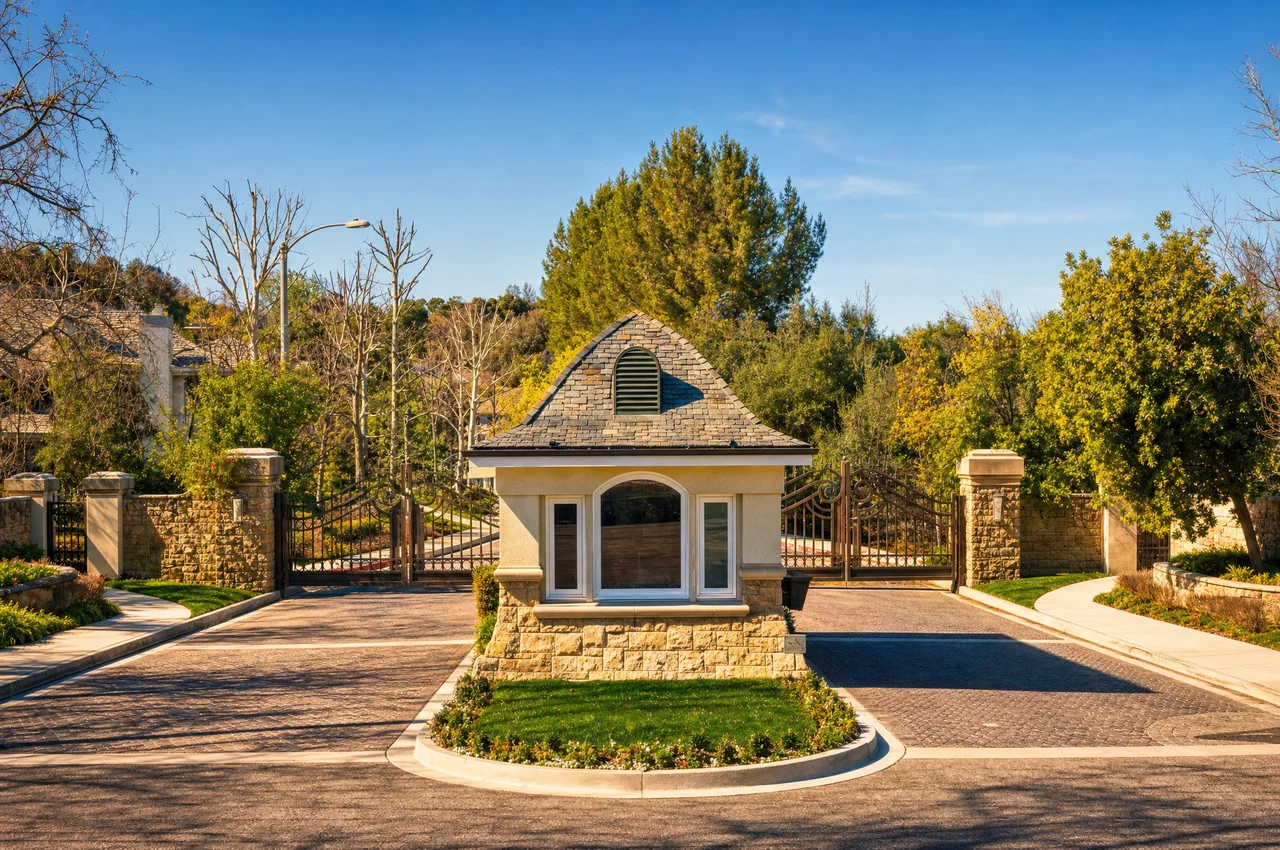

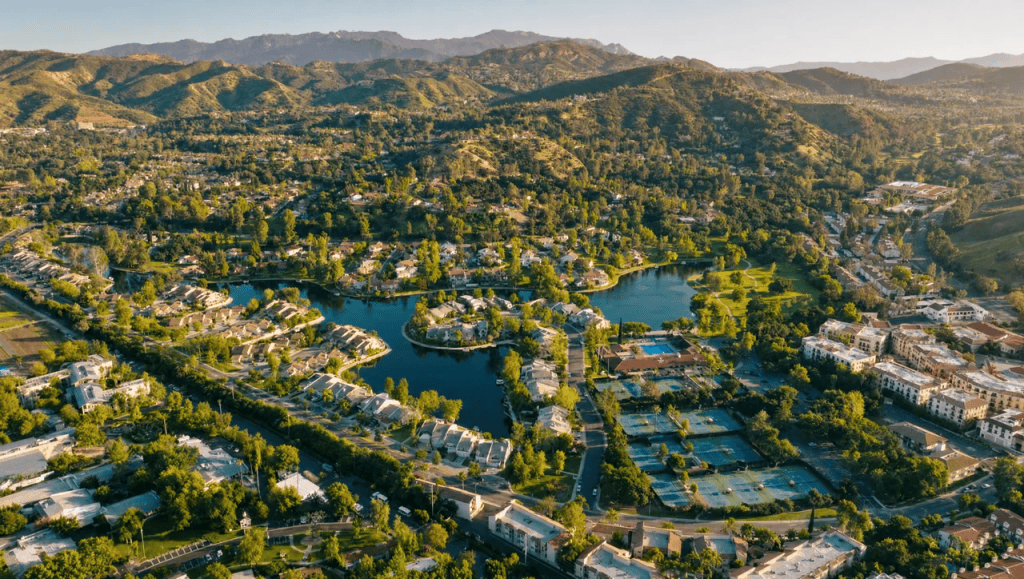
Calabasas has roughly 36 named residential communities, about two-thirds of them gated and around ten with 24-hour staffed guard gates. Hidden Hills is not one of them — it is a separate incorporated city that happens to share the 91302 ZIP code.
The most useful way to hold the map is by which road you take to get there, because that determines your commute, your school assignment, and your daily errands more than any other single factor.
- Off Parkway Calabasas — The Oaks, The Estates at The Oaks, Calabasas Park Estates, Calabasas Hills, Westridge, Vista Pointe, Hidden Hills West. This is the center of gravity: closest to The Commons, Calabasas Lake, and the 101.
- Off Mulholland and Park Granada — Bellagio, The Ridge, Creekside, Clairidge, Calabasas Country Estates, Mountain Park, Park South, Saint Andrews Lane, Abercrombie Ranch Estates, Mulholland Heights, Mulwood, Park Moderne, Calabasas Highlands. Older, hillier, more varied, more private.
- Off Las Virgenes — Mountain View Estates, Mureau Estates, Mont Calabasas, The Colony at Calabasas, El Encanto, Deer Springs, Monte Nido. This is the Malibu side; the beach is roughly twenty minutes down Las Virgenes.
For HOA dues and Mello-Roos by community, see our cost-of-ownership guide.
How should a buyer new to the area narrow down neighborhoods?
Start with five questions, in this order, and let price come last.
- Calabasas or Hidden Hills? A bigger fork than most buyers realize. Hidden Hills means bridle trails instead of sidewalks and no streetlights. Some people hear that and lean in. Some hear it and are out. You learn something in about four seconds.
- Gate or no gate? This can be a status question, a logistics question, or a security question, and which one it is changes the answer completely.
IMPROTA INSIGHT
A staffed gate means every delivery, every contractor, and every guest is a phone call or an app entry. For a client with a security profile, that friction is the entire point. For a family that hosts three nights a week, it’s a tax.
- Location and proximity — schools, shopping, freeways. Out on the backroads off Mulholland or in Monte Nido with solitude and quiet? Or in the center of it all near The Commons — around the lake, Calabasas Park, near the country club?
- View or no view? With topography this hilly, positioning either gives you an incredible view or puts your backyard against a hillside. This is the single biggest swing factor in price and it does not show up in a neighborhood average.
- Era. Calabasas has three building waves that behave like three markets: 1960s–70s ranch stock, 1980s–90s tract and semi-custom, and 2000s Mediterranean, plus the modern rebuilds layered over all of it.
Price comes sixth. By then it is a filter, and it shows buyers what fits within the framework of everything else.
Why published price ranges for Calabasas neighborhoods are misleading
Because within a single community, identical homes sell 40% to 80% apart. Across 38 arm’s-length sales in The Oaks of Calabasas over the trailing two years, house size explains 52% of price variation, and adding lot size gets you only to 54%. Roughly 46% of what a home sells for is driven by view, renovation level, single-story versus two, and position on the street — none of which a range can show you.
Two identical 5,968-square-foot homes in The Oaks sold $4.1 million apart. That is why a price range tells you almost nothing.
The clearest example: two homes at exactly 5,968 square feet. One sold at $4,763,000. The other sold at $8,900,000.
| House size | Spread | Range |
| 5,968 sf | +87% | $4.76M – $8.90M |
| 5,181 sf | +44% | $4.45M – $6.42M |
| 5,056 sf | +26% | $4.85M – $6.10M |
| 4,851 sf | +27% | $3.75M – $4.75M |
| 4,618 sf | +28% | $3.90M – $5.00M |
Lot size does not rescue it. In August 2026 a home on a 0.70-acre lot sold at $845 per square foot, while one two weeks later on a smaller 0.50-acre lot sold at $1,082. The bigger lot sold for less per foot.
So this guide gives you what does not go stale — home count, size range, build era, architecture, lot character, HOA structure, and buyer fit — plus verified current figures where the sales volume supports them.
Calabasas gated communities, one by one
The Oaks of Calabasas
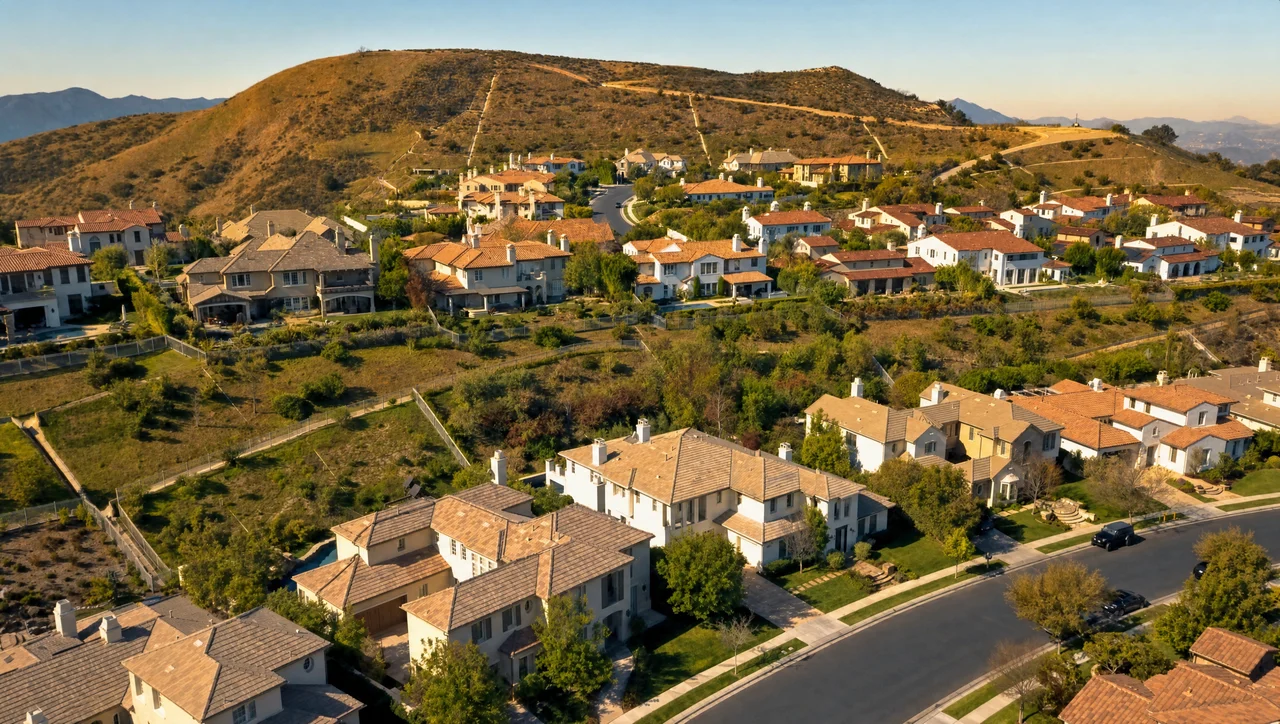

Around 550 homes built 2001–2005, guard-gated, top tier. Mediterranean and Tuscan architecture, coherent by design. Homes run roughly 3,500 to 15,700 square feet, averaging about 5,600. Full amenity package: clubhouse, heated pools, gym, basketball and tennis courts, multiple parks, and a 24-hour guard.
Verified figures across 38 arm’s-length sales over the trailing two years: median sale $5,183,750, middle 50% between $4.49M and $6.18M, median lot 0.43 acre, median 33 days on market, median sale at 94.5% of asking. Only 4 of 35 sales closed at or above list.
What each budget bought:
| Budget | Sales | House size | Lot (median) | Median $/sf |
| $2–3M | none | — | — | — |
| $3–4M | 6 | 3,739–4,851 sf | 0.33 ac | $889 |
| $4–5M | 10 | 4,342–5,968 sf | 0.44 ac | $969 |
| $5–6M | 11 | 5,030–6,686 sf | 0.42 ac | $994 |
| $6–8M | 8 | 5,056–7,196 sf | 0.45 ac | $1,090 |
| $8–11M | 3 | 5,968–7,000 sf | 0.60 ac | $1,396 |
The buyer: wants the amenity set and the security posture without an acreage obligation.
An important correction for anyone shopping it: at a 0.43-acre median lot, The Oaks is large houses on suburban lots, not estate living. And budget buys house, not land — lot size moves only from 0.33 to 0.45 acre across a $3 million price swing.
The Estates at The Oaks
A separate gate inside The Oaks — the gate behind the gate — producing two to three sales a year. Ten sales over four years: median $8,800,000, middle 50% between $7.64M and $11.46M, homes 7,988–14,715 sf (median 9,697), lots 0.80–1.63 acres (median 0.97).
The counterintuitive finding: The Estates sells for less per square foot than The Oaks — median $951 versus $1,002. The inner gate is not a premium-per-foot product. What the money buys is land and scale. The smallest Estates lot in four years, 0.80 acre, is larger than 75% of everything that sold in The Oaks.
Which produces the most useful comparison in the entire dataset:
| At $8–11M | House (median) | Lot (median) | Median $/sf |
| The Oaks | 6,266 sf | 0.60 ac | $1,396 |
| The Estates | 10,160 sf | 1.06 ac | $914 |
Same money, roughly 60% more house, nearly double the land, two-thirds the price per foot. A buyer stretching for one of the best homes in The Oaks should look at the entry point of The Estates instead.
Estates sellers also systematically overprice: zero of eight arm’s-length sales closed at or above list, and the three largest homes to sell closed at 88.8%, 84.4%, and 80.0% of asking. There is an active listing at 321 days and one past sale that took 788.
A tell: you can identify which side of the inner gate an address is on from the street name. The Oaks proper uses concrete nature nouns — Naranja, Las Fresas, Las Uvas, De Oro, Las Bellotas, Los Caballos. The Estates uses abstractions — Prado De La Magia, Del Misterio, De La Felicidad, Del Grandioso, De Los Suenos.
Westridge
A 267-home guard-gated community built 1987–1991, upper tier, and the most walkable guard-gated address in Calabasas. Homes range roughly 3,300 to 9,166 square feet with three- to seven-bedroom floor plans on generous lots. Elevated terrain gives most homes panoramic valley, city-light, and mountain views.
Its real differentiator is location: Calabasas Lake, The Commons, the farmers market, and everyday shopping are within walking distance. Very few guard-gated communities anywhere offer that.
What moves the number here: view orientation, whether the lot is flat, and garage count. Flat-lot homes with south-facing views and three-car garages trade fastest.
The buyer: wants a staffed gate and panoramic views but does not want to drive for a carton of milk.
Calabasas Park Estates
A gated community around Calabasas Lake, mid-to-upper tier, with homes up to roughly 5,600 square feet. Predominantly 1970s–80s ranch and traditional stock with a heavy remodel overlay — a large share has been taken to studs and rebuilt.
What moves the number here: condition, and it is not close. This is where the renovation spread is widest in Calabasas — original systems versus a full rebuild can be a two-times difference on the same floor plan. Lake proximity is second.
The buyer: wants Las Virgenes schools and a real neighborhood feel, is comfortable buying either a project or a recent flip, and does not need a guard.
The Ridge
Approximately 50 guard-gated estate homes within Calabasas Park, upper tier. Floor plans run three to seven bedrooms across roughly 4,000 to 10,000 square feet, with easy 101 access.
The buyer: wants estate scale and a staffed gate in a small community where you will know your neighbors. Low turnover by virtue of size.
Calabasas Hills and Calabasas Hills Estates
Two related but distinct communities that buyers mix up constantly. Calabasas Hills is the larger — roughly 490 homes from about 1,540 to 5,312 square feet, mostly built in the late 1980s, walking distance to Bay Laurel Elementary and Calabasas Hills Park. It is entry-to-mid tier and among the more attainable gated addresses in the city. Calabasas Hills Estates is much smaller: 48 single-family homes of roughly 2,000 to 2,900 square feet near the Calabasas Country Club.
What moves the number here: single-story versus two — the one-story premium is real — then condition, then which of the two communities you are actually in.
The buyer: the schools-first family. This is one of the most school-driven neighborhoods in Calabasas.
Mountain View Estates
A guard-gated community at Mureau Road and Mountain View Drive, older than The Oaks and built on larger, more individual lots. Upper tier. Private park plus direct trail access, including the Henry Ridge trail and its intersection with the Summit-to-Summit trail — ocean views on one side, valley on the other. Minutes from The Commons and the 101.
There is less architectural uniformity here than in the 2000s communities, which reads as character to some buyers and inconsistency to others.
What moves the number here: ridge position and view above all, then lot size, then whether the home has been rebuilt. Given the age of the stock, the condition spread is enormous.
Mureau Estates
A very small guard-gated community of large detached homes between Mountain View Estates and Hidden Hills. Upper tier. Its defining fact is scale — there are very few homes, so turnover is a function of life events rather than pricing. This is a community where entry depends on timing and access, not budget.
Vista Pointe
A gated community on the ridge between the 101 and Parkway Calabasas Road, near the Calabasas Country Club. Mid-to-upper tier.
What moves the number here: golf-course frontage versus interior position, then view, then condition.
Mont Calabasas
A 24-hour guard-gated community at one of the highest points in Calabasas, north of the 101, with the first homes built in 2001. Mid-to-upper tier. The elevation is the product — this is a view community first.
Mountain Park
A gated community at the west end of Calabasas, set into the canyons of the Santa Monica Mountains. Mid-to-upper tier, and one of the more private addresses in the city by virtue of terrain rather than security infrastructure.
The buyer: wants canyon seclusion without leaving a gated community. Worth pairing with the insurance conversation early — canyon terrain and limited access affect coverage.
Park South Calabasas
A gated community off Mulholland Drive at Park South Street, directly across from Viewpoint School. Upper tier. The private-school adjacency is the defining feature and drives a specific buyer.
Calabasas Country Estates
A gated community in the Mulholland corridor, mid-to-upper tier. Older stock on larger, more varied lots than the Parkway Calabasas communities.
Clairidge
A gated community of homes from roughly 3,000 to 5,000-plus square feet. Spelled C-L-A-I-R-I-D-G-E, not “Claridge.” Mid-to-upper tier.
Oak Creek Estates
A gated community of 34 luxury homes, many with private tennis courts and pools. Mid-to-upper tier. At 34 homes, turnover is limited and inventory is unpredictable.
Bellagio
A gated community of approximately 160 homes at roughly 3,000 to 4,000 square feet. Mid tier — one of the more accessible entry points into gated Calabasas.
What moves the number here: condition and interior position. A home backing open space and a home backing a neighbor are different products.
The Colony at Calabasas
A gated community of 50 homes off Las Virgenes Road, with floor plans from roughly 2,880 to 3,080 square feet. Mid tier. Notably close to Malibu — the beach is a short drive down Las Virgenes.
Saint Andrews Lane Estates
A gated enclave of just four homes off Mulholland Highway. Upper tier. With four parcels there is no market rate — only what the last one traded for, and when.
Country Ridge Estates
A boutique gated development of eight new-build estate residences in the Santa Monica Mountains foothills, bordered by a nature preserve. Top tier. Homes run roughly 5,000 to over 10,000 square feet in contemporary and Mediterranean styles, with panoramic canyon views on generous lots.
New construction of this kind is genuinely rare in Calabasas, which is the community’s main argument. At eight homes, availability is essentially random.
Abercrombie Ranch Estates
Thirteen gated parcels ranging from 3 to 18 acres — structurally unlike anything else in Calabasas. Top tier. This is the closest thing the city has to true ranch acreage inside a gate. With 13 parcels there is no market rate.
Creekside
A gated community of three sub-neighborhoods containing detached and free-standing townhomes, two to four bedrooms, roughly 2,100 to 3,100 square feet. Entry tier, and one of the most attainable gated options in Calabasas.
El Encanto
A small gated community built in 1988, Spanish architecture, homes roughly 1,800 to 2,500-plus square feet with three to four bedrooms. Entry tier, off the Las Virgenes corridor.
Via Mira Monte
A gated community built in the early 2000s with homes from roughly 2,500 to 3,200 square feet. Entry-to-mid tier. Three words — Via Mira Monte.
Country Creek Lane
A gated community in northern Calabasas, near A.E. Wright Middle School. Entry-to-mid tier, and a genuinely school-convenient address for middle-school families.
Hidden Hills West
A gated community in Calabasas at the west end of Parkway Calabasas, right off the freeway exit. It is not Hidden Hills. Upper tier. It sits outside the Hidden Hills gates, carries no Hidden Hills Community Association membership, and is a City of Calabasas address. The name causes more confusion than any other in the area.
Calabasas neighborhoods that aren’t gated
Calabasas Lake
The non-gated neighborhood around the lake itself, walkable to The Commons. Mid-to-upper tier. It trades on location and walkability rather than security infrastructure — a real distinction in a city with a Walk Score of 23.
Classic Calabasas
The established non-gated core of the city. Mid tier, primarily 1970s–80s stock with substantial remodel activity.
Mulwood (Greater Mulwood)
One of the older parts of Calabasas, in the Mulholland and Park Granada corridor. Entry-to-mid tier. Varied stock, more character than uniformity, and one of the better value propositions for Las Virgenes schools.
Mulholland Heights
A non-gated hillside neighborhood accessed from Park Granada or Mulholland Drive. Mid tier, with view potential varying dramatically by position.
Park Moderne — the Bird Streets
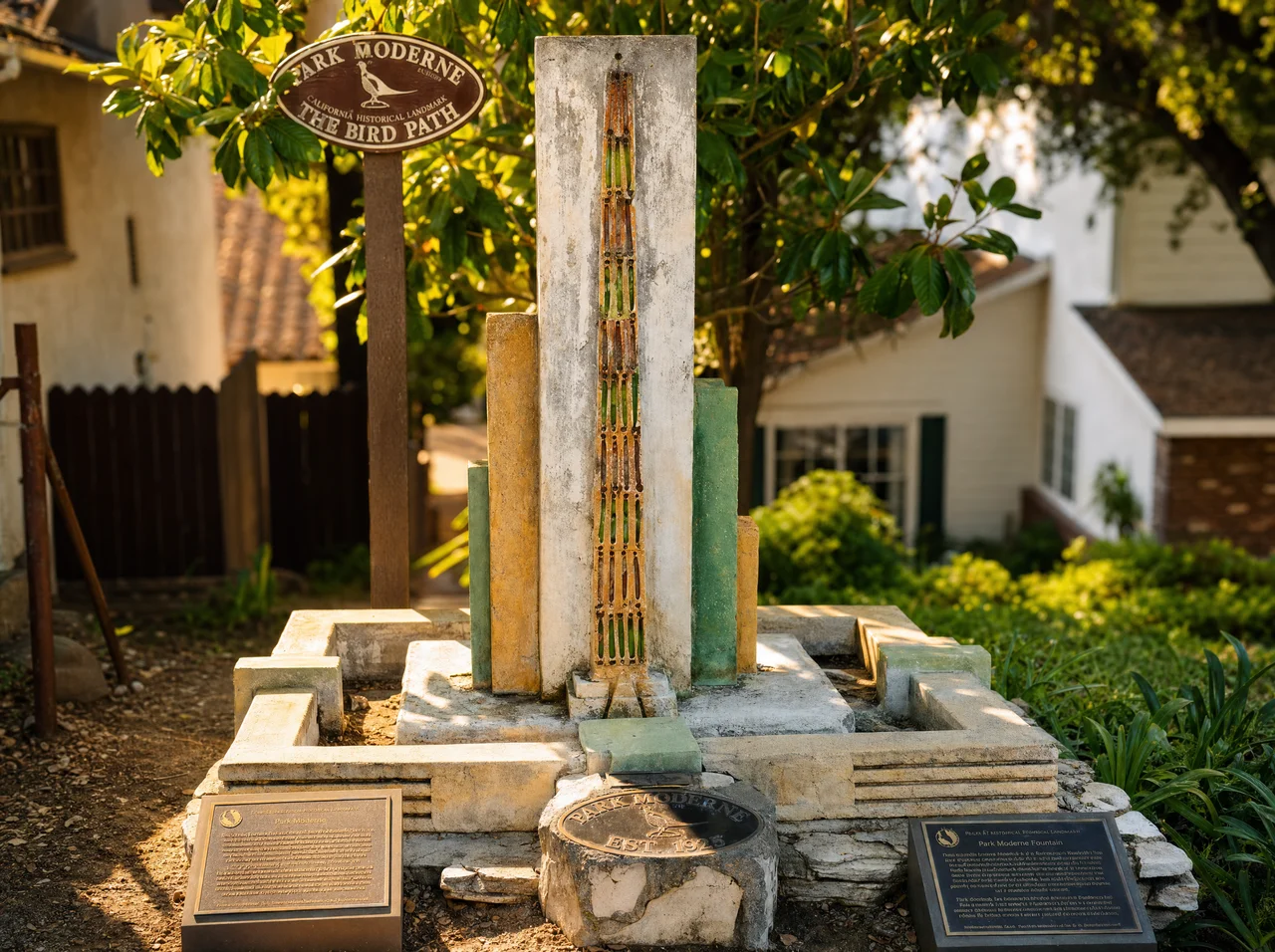

The oldest planned subdivision in Calabasas, founded in 1927 as an avant-garde artists’ colony, with every street named for a bird species. Developer William Lingenbrink partnered with modernist architect Rudolph Schindler and homesteader Samuel Cooper Jr. to subdivide 140 acres of ranch land into 174 lots of 5,000 square feet each. Lots originally sold for $100 to $350.
Residents included sculptor Andy Anderson, portrait painter Paul von Klieben, songwriter Dick Coburn, and local historian Laura B. Gaye. Most of the original homes were replaced in the 1960s, but two elements survive as City of Calabasas Historic Landmarks, both designated June 8, 2011: the Park Moderne Fountain (Landmark 6), an eight-foot Art Deco terraced pyramid of multicolored concrete and inset glass designed by architect Jock Peters, and the Bird Path (Landmark 5), the last remaining footpath from the original development, running about 125 feet from Bluebird and Meadowlark up to Blackbird Way.
Entry-to-mid tier, located behind Calabasas High School within Greater Mulwood.
The buyer: wants character and history over conformity, and does not mind small lots.
Calabasas Highlands
The hillside canyon pocket, non-gated, and the lowest detached entry point into Las Virgenes schools. Entry tier.
What moves the number here: road access and driveway grade first — this is the one community where access dominates the number — then view, then whether the parcel has a usable flat pad at all.
The buyer: wants the Calabasas address and the schools at the lowest available detached price, and genuinely likes canyon living. For the right person this is a preference, not a compromise.
Deer Springs
A non-gated pocket off the Las Virgenes corridor. Mid tier, convenient to the Malibu side.
Saratoga Hills
A non-gated neighborhood on the north side of the freeway at Lost Hills. Entry-to-mid tier. Being north of the 101 changes both the commute pattern and the price relative to comparable stock south of it.
Monte Nido
An unincorporated community in Malibu Canyon, in its own small valley, surrounded by parkland. Mid-to-upper tier depending heavily on parcel. Not gated — the privacy comes from geography rather than a guardhouse.
Important: Monte Nido is unincorporated Los Angeles County, not the City of Calabasas, which means different governance and different fire response. Insurance deserves particular attention here.
How do the three Hidden Hills gates differ?
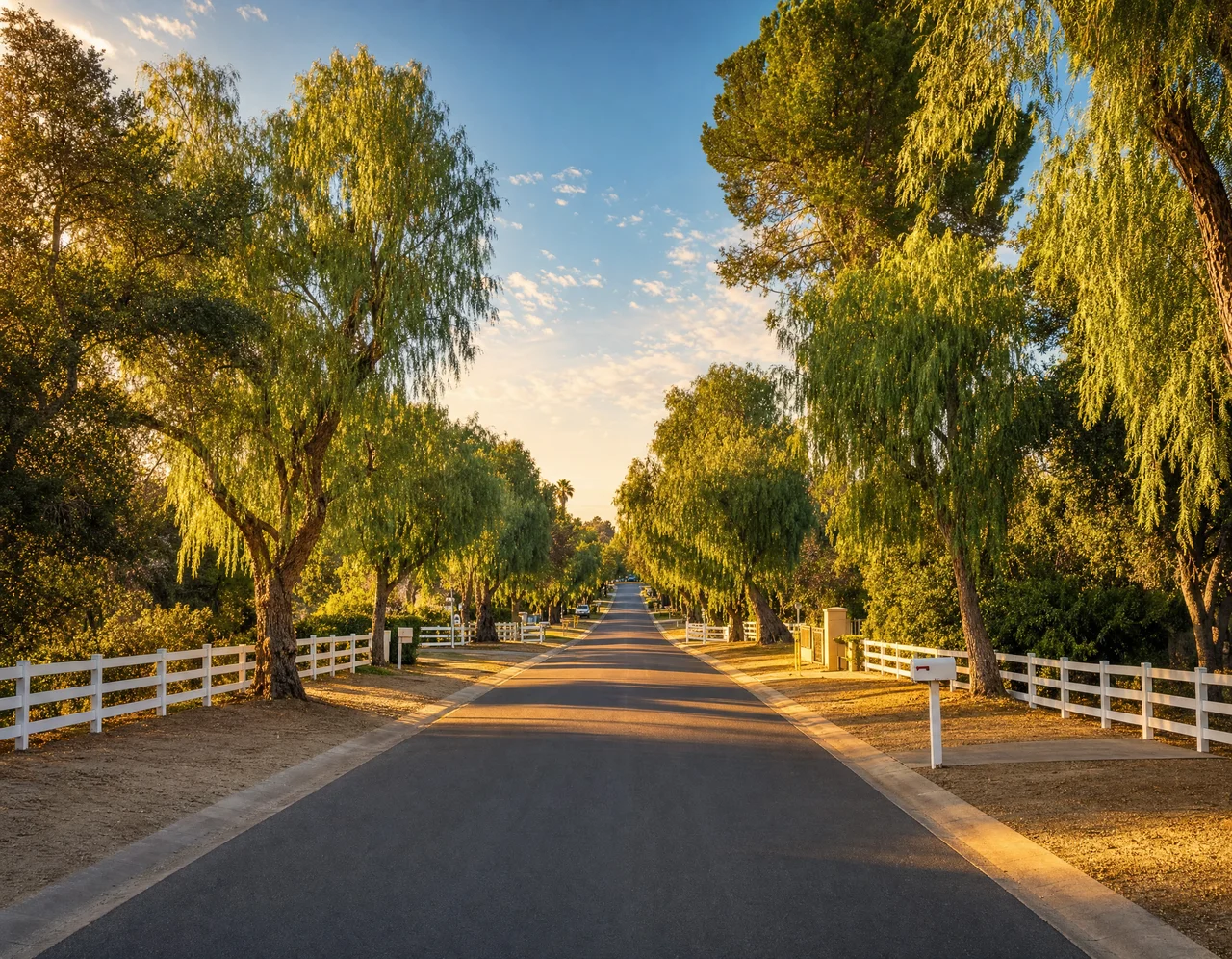

They don’t, in the way buyers expect. Hidden Hills is one community with three entrances that all connect to the same street network. There is no “living behind a different gate.” A resident on Ashley Ridge and a resident on Long Valley are neighbors on the same private roads, and either can come and go through any of the three.
This is the opposite of the structure inside The Oaks, where The Estates is a genuine sub-market with its own gate and its own price tier. Buyers arriving from other markets frequently assume Hidden Hills works the same way.
Hidden Hills is an incorporated city of about 650 home sites across roughly 1.6 square miles, designed in the 1950s by A.E. Hanson — the landscape architect behind Rolling Hills and Palos Verdes Estates — and incorporated in 1961 to preserve its equestrian character against valley development. One-acre minimum lots, mandatory equestrian zoning, no sidewalks, no streetlights. Round Meadow Elementary sits inside the city limits and serves Las Virgenes Unified.
On the gate names, a correction worth making. The Hidden Hills Community Association’s own gate directory lists three gates: Long Valley, Round Meadow, and Burbank. The city’s published directions confirm that Burbank Boulevard becomes Spring Valley Road as you enter, which is why the north gate is commonly called Spring Valley in conversation and Burbank on the official roster. Several real estate sites publish a “Jed Smith gate” — Jed Smith is a street, not a gate, and no city or association source lists one.
What the gates do: all three are staffed continuously. Visitors and contractors clear the guard. Residents pre-clear guests through the association system or by phone, and contractors need current approval on file. Round Meadow families enter on a school clearance list during school hours.
What the association maintains: roughly six miles of private road, three gatehouses, about 25 miles of bridle trails, three riding arenas, three tennis courts, four pickleball courts, a competition-size pool, a recreation center, and a 99-seat performing arts theater.
Since the gates do not segment the market, what does? Lot-level attributes: flat usable acreage versus hillside, proximity to Round Meadow Elementary, and proximity to the arenas and trailheads — the Spring Valley arena carries the event amenities, including round pens, dressage areas, water troughs, a snack shack, and restrooms. Newer construction on Ashley Ridge trades differently from original ranch stock. Lasher Road reads as the most secluded, with longer driveways and larger lots.
How prices behave: Hidden Hills trades thinly, with single-digit sales in a typical quarter. Published medians swing wildly as a result — you will see figures from $5M to over $8M depending on source and month, and both can be accurate. Days on market runs long, and well past 150 days is unremarkable. Buyers read long days on market as weakness. In a city of about 650 homes it usually means the right buyer had not shown up yet.
A detail that explains the place: the streets are named for frontier explorers — Jed Smith, Jim Bridger, Kit Carson, John Colter, John Fremont, Lewis and Clark, Annie Oakley, Bill Cody, Jacob Hamblin, William Bent. It tells you the community was designed as one idea in the 1950s rather than assembled parcel by parcel.
Which Calabasas neighborhoods do buyers misunderstand?
- Hidden Hills West is in Calabasas. It is not Hidden Hills. Not behind the gates, no association membership, different city. The name causes confusion in both directions.
- Hidden Hills itself is more rural than its reputation. Buyers assume the most exclusive address is the most polished. It is the opposite — no sidewalks, no streetlights, equestrian zoning, and an association design review with opinions. Buyers coming from Beverly Hills or the Palisades are routinely surprised.
- The Oaks is two markets, not one, and they differ by more than $3.6 million at the median.
- The Oaks is not estate living. Median lot, 0.43 acre.
- Calabasas Hills and Calabasas Hills Estates are different communities — roughly 490 homes versus 48.
- Calabasas Highlands gets written off on price per foot. What it offers is canyon living in the same school district as neighborhoods at three times the price.
- Calabasas Park Estates looks dated in photos and often isn’t — much of the stock has been rebuilt to studs.
- Park Moderne isn’t just old housing stock — it is the first planned subdivision in the city and holds two designated historic landmarks.
- The 91302 ZIP code is not a market. It covers Calabasas, Hidden Hills, and unincorporated pockets with different governance and different fire response.
Where is the value in Calabasas right now?
The gap between asking prices and sale prices is where the leverage is. As of mid-2026, inventory is up, days on market has stretched, and price reductions have climbed year over year. In The Oaks, the median sale closed at 94.5% of list, only 4 of 35 sales reached asking, and active listings sit at a median 86 days.
- Calabasas Highlands — the lowest detached entry into Las Virgenes schools. The discount is priced for road access, which does not get worse.
- Mid-tier gated communities without marquee names — Bellagio, Creekside, The Ridge, Oak Creek Estates. Less search traffic, so they sit, so they negotiate.
- Mulwood and Park Moderne — character stock at entry-tier pricing in the same school district as everything else.
- Well-located 1970s–80s stock with original systems. With buyers rate-sensitive and reluctant to take on projects, the renovation discount has widened.
Two cases that argue both sides. One home on Prado De Oro, 5,056 square feet, sold in December 2025 at $4,850,000 and again in August 2026 at $6,100,000 — up 25.8% in seven months, and it relisted at $6,895,000 and still closed at 88.5% of that. Meanwhile a 4,851-square-foot home on the same street was bought off-market in December 2024 at $3,750,000 and is currently listed at $4,100,000, unsold at 135 days.
IMPROTA INSIGHT
Buying off-market is not the same as buying well.
Which Calabasas communities are hardest to buy into?
The constraint is inventory, not price — and in the tightest communities roughly one in ten sales never reaches the open market. In the trailing two years of Oaks sales, 4 of 39 closed at zero days on market at exactly 100% of list. In The Estates, 2 of 10 over four years.
- Saint Andrews Lane Estates — four homes.
- Country Ridge Estates — eight homes.
- Abercrombie Ranch Estates — thirteen parcels.
- Mureau Estates — too small to have a market.
- The Estates at The Oaks — two to three sales a year.
- Oak Creek Estates and The Ridge — 34 and roughly 50 homes.
- Hidden Hills flat parcels — hillside lots exist; flat usable acreage does not get made.
- Park Moderne — small, and held by owners whose reasons are not financial.
What it takes: being known to the listing side before there is a listing, and being ready. Proof of funds current, lender letter current, decision-makers reachable within the hour.
What are the downsides of buying in Calabasas and Hidden Hills?
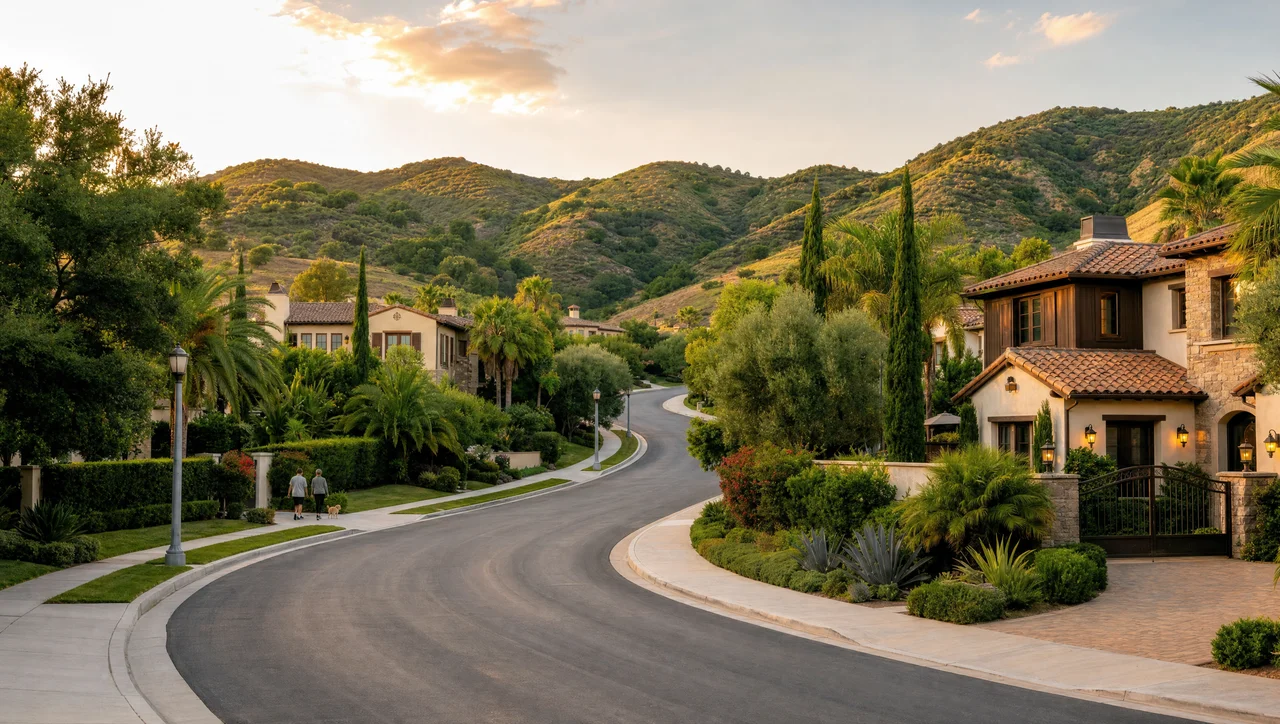
Insurance is the biggest one, and it applies to nearly the entire area. Calabasas sits within a Very High Fire Hazard Severity Zone under CAL FIRE’s current map published March 2025, triggering Chapter 7A construction standards and defensible-space requirements. Canyon-adjacent areas with limited road access and heavy vegetation — Calabasas Highlands, Monte Nido, Mountain Park, Hidden Hills, and the Malibu Canyon corridor — sit at the harder end.
- Quote insurance before you write an offer, not during escrow. A specialist broker needs two to three days. The most common way a deal here dies is discovering in week three that coverage costs five figures a year.
- The FAIR Plan is a realistic outcome, not a worst case. In the highest-risk ZIP codes statewide, roughly 41% of homes were on it as of March 2026. FAIR Plan dwelling coverage caps around $3 million, so most homes in this price range need excess coverage layered above it.
- Budget the whole stack. A Difference in Conditions wrap typically adds 25–60% on top of the FAIR Plan premium. The FAIR Plan requested a 35.8% average rate increase in October 2025; the California Department of Insurance approved 29.1%, effective October 15, 2026.
- Lenders will not fund without bound coverage. Most conventional, FHA, and VA lenders accept the FAIR Plan as qualifying; some require the DIC companion.
- Documented mitigation moves the needle. Class A roof, ember-resistant vents, Zone 0 clearance, defensible space. The FAIR Plan launched twelve hardening discounts in November 2025 combining to as much as 16.4% off the wildfire portion of premium.
- Sellers must disclose. Non-renewal notices and active FAIR Plan policies are material facts.
Mello-Roos. Some Calabasas neighborhoods carry it, many do not, and it tracks with newer master-planned development. California residential assessments commonly run from a few hundred dollars to over $5,000 annually and can escalate up to 2% per year. It is a per-parcel number — check the tax bill, the preliminary title report, and the NHD report for the specific property.
Traffic. The 101 corridor to downtown and the Westside congests predictably and badly.
Road access in the canyon communities. Calabasas Highlands, Monte Nido, Mountain Park, and the canyon pockets have narrow roads with limited egress. That is three separate issues people treat as one: daily convenience, fire evacuation, and insurance rating.
Gate friction. In Hidden Hills, contractors need current approval on file, which affects renovation timelines in ways buyers do not anticipate.
Design review. The Hidden Hills association oversees construction and modification across all 650 home sites. Buyers planning to close and immediately rebuild need that timeline before writing.
Equestrian zoning. Hidden Hills’ one-acre minimums and mandatory equestrian zoning are a feature for horse owners and a constraint for everyone else.
Governance differences. Monte Nido is unincorporated county, not city — different rules, different fire response.
What actually makes a buyer choose one neighborhood over another?
Schools flip fewer decisions than buyers expect, because Calabasas and Hidden Hills are both Las Virgenes Unified. A family moving between neighborhoods inside this guide usually is not changing districts. What moves them is the specific elementary assignment and the middle-and-high split — answerable with a boundary map in ninety seconds.
Commute flips more than buyers admit. Not the mileage, the on-ramp. Two homes six minutes apart can differ by twenty minutes at 8 a.m. depending on which direction they travel to reach the 101. Drive it at the actual hour.
Privacy is the decider at the top of the market. Not whether it is gated — sightlines, service entrance, whether the street dead-ends, how the gate handles a vehicle that is not on the list. That is why the same buyer will pay meaningfully more for one street than another inside the same community.
Insurance is now a decision-flipper, and that is new. Buyers have changed neighborhoods over a coverage quote. It functions as a second price — one that does not appear on the listing and cannot be financed away.
Walkability flips almost nothing here — Calabasas has a Walk Score of 23. The exceptions are real, though: Westridge, Calabasas Lake, and the Commons-adjacent pockets are genuinely walkable, and for buyers who want that, those three are effectively the whole list.
And there is one buyers never name.
IMPROTA INSIGHT
Buyers come in saying “view,” and half of them mean “yard.” Flat usable space outranks square footage and it outranks views, especially for families with young children — and more budget does not solve it. In The Oaks, lot size barely moves across a $3 million price range.
Complete roster
Gated (guard-gated unless noted) — The Oaks of Calabasas · The Estates at The Oaks · Mountain View Estates · Mureau Estates · Vista Pointe · Westridge · The Colony at Calabasas (no guard) · Mont Calabasas · Mountain Park · Calabasas Country Estates · Abercrombie Ranch Estates (no guard) · Saint Andrews Lane Estates · Park South Calabasas · Clairidge · Calabasas Park Estates · Calabasas Hills and Calabasas Hills Estates (no guard) · Bellagio · The Ridge · Creekside (no guard) · Oak Creek Estates · El Encanto (no guard) · Via Mira Monte (no guard) · Country Creek Lane · Hidden Hills West (no guard — in Calabasas, not Hidden Hills) · Country Ridge Estates
Not gated — Classic Calabasas · Calabasas Lake · Calabasas Highlands · Mulwood · Off Mulholland · Mulholland Heights · Park Moderne (the Bird Streets) · Deer Springs · Saratoga Hills · Monte Nido
Hidden Hills — a separate incorporated city. Areas within it: Long Valley, Round Meadow, Spring Valley, Ashley Ridge, Jed Smith, Lasher Road.
Frequently asked questions
Is Hidden Hills part of Calabasas?
No. Hidden Hills is its own incorporated city of roughly 650 home sites, with its own city government, private roads, and community association. It shares the 91302 ZIP code with Calabasas and both are served by Las Virgenes Unified, which is why the two are so often confused. Hidden Hills West, despite the name, is a City of Calabasas address outside the Hidden Hills gates.
How many gated communities are in Calabasas?
Calabasas has roughly 36 named residential communities, about two-thirds of which are gated. Around ten have 24-hour staffed guard gates, including The Oaks of Calabasas, The Estates at The Oaks, Westridge, Mountain View Estates, Mureau Estates, Mont Calabasas, and The Ridge. The rest use unstaffed gates.
Do the three Hidden Hills gates create different neighborhoods?
No. All three gates open onto the same private street network, so there is no separate market behind any one of them. What actually separates one Hidden Hills property from another is lot-level: flat usable acreage versus hillside, proximity to Round Meadow Elementary and to the arenas and trailheads, and whether the home is newer construction or original ranch stock.
Which Calabasas neighborhood is the most affordable way into Las Virgenes schools?
Calabasas Highlands is generally the lowest detached entry point. It is a non-gated hillside canyon pocket, and its discount is priced primarily for road access and driveway grade rather than for the schools, the address, or the district — all of which are identical to neighborhoods trading at several times the price.
Do homes in Calabasas and Hidden Hills need special fire insurance?
Most do. Calabasas sits within a Very High Fire Hazard Severity Zone under CAL FIRE’s map published in March 2025. Many homes end up on the California FAIR Plan, which caps dwelling coverage around $3 million and therefore usually requires a Difference in Conditions policy layered above it. Quote coverage before writing an offer — a specialist broker needs two to three days, and lenders will not fund without bound coverage.