



What Does It Really Cost to Own a Home in Calabasas and Hidden Hills?
Every buyer who sits down with us asks about the mortgage payment. Far fewer ask what it costs to keep the house once they own it. In Calabasas and Hidden Hills, that second number matters more than almost anywhere else in Los Angeles County.
In more than 20 years of combined experience helping families buy and sell here, we have watched carrying costs catch smart, well-prepared buyers off guard. Not because anyone hid anything, but because those costs live in places a listing sheet never shows: a line item on the county tax bill, an association assessment tied to your purchase price, and an insurance market that changed dramatically after the January 2025 wildfires.
This guide walks through every major carrying cost we discuss with our buyers: property taxes, Mello-Roos, HOA dues, the Hidden Hills Community Association assessment, and homeowners insurance. At the end, we sketch a real annual breakdown for each community and share what we tell every buyer to do before removing contingencies.
What does it really cost to own a home here beyond the mortgage?
The short answer: your purchase price sets your property tax, and your community, your lot, and the fire map set almost everything else.
Here is the framework we use with clients. Carrying costs in Calabasas and Hidden Hills fall into two buckets.
- Fixed costs are the ones you can pin down before you close: property taxes, any Mello-Roos or special charges on the tax bill, HOA dues, and in Hidden Hills, the Community Association assessment. These are predictable, and they are the focus of the breakdown later in this guide.
- Variable costs depend on the property and on you: insurance, landscaping, pool service, utilities, and the general upkeep that comes with an estate-sized home.
Insurance technically belongs in the variable bucket, but in today’s market it behaves like its own category, and it is the cost that surprises people most. The other surprise is timing. Your property tax bill does not stop at closing. A supplemental bill arrives months later, and it usually is not paid through your lender’s impound account.
Neither of these is a reason to walk away from a great home. They are reasons to plan.
How do property taxes work in Calabasas and Hidden Hills?
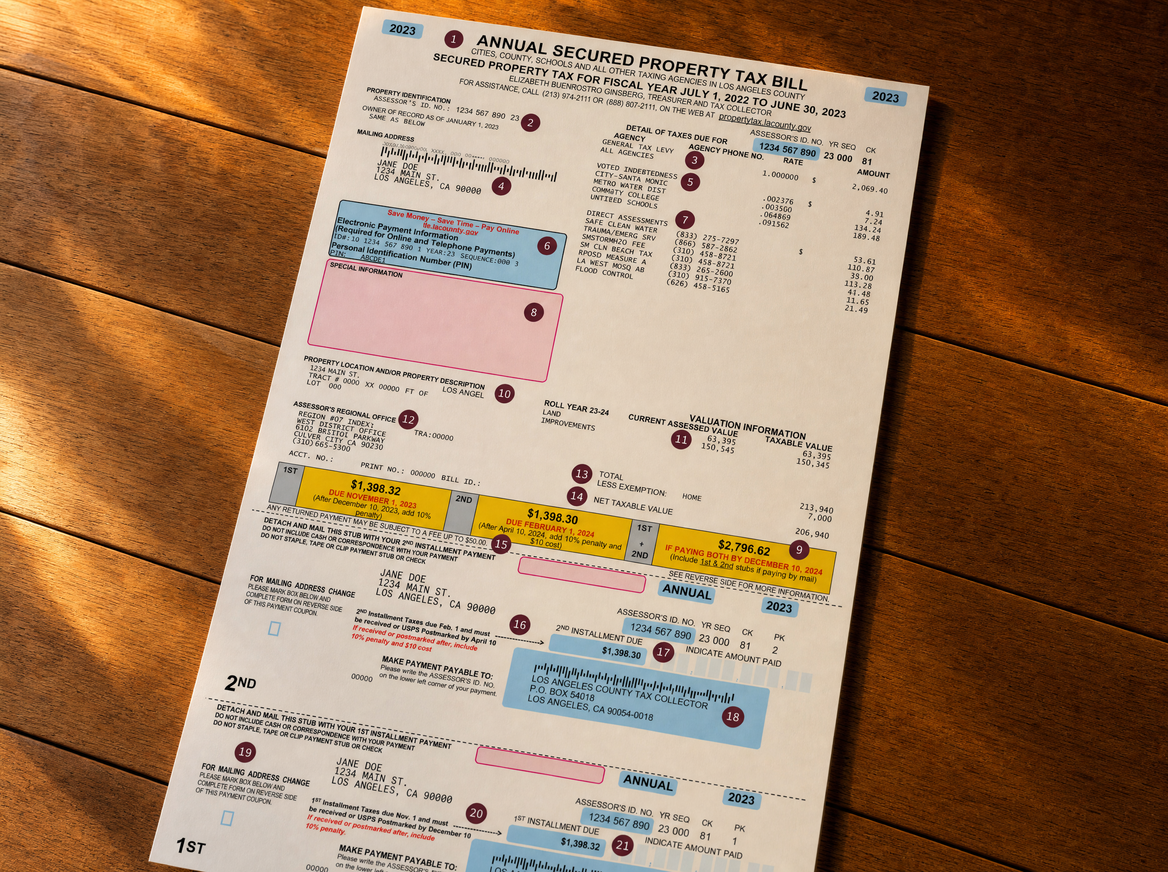

The base rules are nearly identical in both cities. Because Calabasas and Hidden Hills sit side by side in Los Angeles County, both operate under California’s Proposition 13. That means the same 1% base ad valorem tax rate, applied to your purchase price, with annual increases in your assessed value capped at 2% for as long as you own the home.
Both cities are also served by the same top-rated school district, Las Virgenes Unified (LVUSD), so the voter-approved school bonds added to the tax bill are identical. Once those bonds and other local levies are added to the 1% base, the total typically lands around 1.1% to 1.2% of your purchase price. For planning purposes, we use 1.15%.
Where the two cities differ is in the add-ons: fixed-dollar charges that appear as separate line items on the bill. In Calabasas, depending on the neighborhood, that can include Mello-Roos. We cover it below.
| Improta Insight
The seller’s tax bill tells you almost nothing about yours. Under Prop 13, your tax is based on your purchase price, not on what the seller paid. A seller who bought 20 years ago may be paying a fraction of what you will. Always budget from the price you are paying. |
What is the supplemental tax bill?
This is the one that catches people. When you buy a home, the Los Angeles County Assessor reassesses it at your purchase price. If that value is higher than the seller’s old assessed value, and in these markets it almost always is, the county issues a supplemental tax bill for the difference, prorated for the rest of the fiscal year.
- It arrives months after closing, often when you have stopped thinking about the purchase.
- It usually comes to you directly rather than to your lender, so your impound account typically does not cover it.
- In your first year of ownership, you can receive the regular bill plus one or two supplemental bills.
| Improta Insight
Set cash aside at closing for the supplemental bill. On a multimillion-dollar purchase, it can be a significant check, and it tends to arrive right when new owners are spending on furniture and projects. |
Which Calabasas communities have Mello-Roos, and what does it cost?
Mello-Roos is a special tax levied through a Community Facilities District (CFD), a financing tool California created in 1982 to pay for infrastructure such as roads, sewers, and retaining walls in new developments. It is not based on your home’s value. It is a fixed-dollar amount that appears as its own line on your property tax bill, and it continues until the district’s bonds are paid off.
In Calabasas, most established neighborhoods do not have Mello-Roos, because many of the city’s residential tracts predate the widespread use of CFDs. Some of the upscale gated communities built from the late 1990s onward do.
- The Oaks of Calabasas is the most prominent example. The developer used CFD financing for the infrastructure its rolling hillsides required. We estimate homeowners typically pay roughly $2,000 to $4,000 or more per year in Mello-Roos, as a line item on the county tax bill.
- Calabasas Park Estates, Mountain View Estates, and Mulholland Heights do not carry Mello-Roos.
- Newer pocket tracts and custom developments, especially townhome or luxury condo communities built in the last 15 to 20 years, can carry a CFD even when the surrounding neighborhood does not. These always warrant an address-specific check.
How do you verify what a specific home pays?
Listing sheets often quote only the base tax rate. During escrow, have your agent pull the current secured property tax bill for the home. Mello-Roos and other special charges are never hidden inside the purchase price. They appear explicitly as fixed-dollar direct assessment or CFD line items.
One more note: unlike ordinary property taxes, Mello-Roos is generally not federally tax-deductible, because it is treated as an assessment for local benefits rather than an ad valorem tax. The rules have nuances, so ask your CPA how they apply to you.
How much are HOA dues in Calabasas gated communities?

Monthly HOA dues for single-family homes in Calabasas gated communities run from about $210 to more than $700. The spread comes down to two things: the level of security, meaning a 24/7 staffed guard gate versus electronic fob access, and how many shared amenities the community maintains.
| Community | Typical monthly HOA dues |
| The Oaks of Calabasas | $417–$500 |
| The Estates at The Oaks | $700+ |
| Mountain View Estates | $575–$620 |
| Calabasas Park Estates | $210–$395 |
| Calabasas Hills / Calabasas Hills Estates | $220–$340 |
What do the higher dues pay for?
- The Oaks of Calabasas funds 24/7 double guard gates, security patrols, a clubhouse, tennis courts, and private parks. The Estates at The Oaks carries the highest dues in the city, starting around $700 a month.
- Mountain View Estates dues primarily fund its 24/7 guard-gated entrance, private road maintenance, and neighborhood security.
- Calabasas Park Estates, next to the Calabasas Country Club, offers security patrols and manicured common areas but fewer resort-style amenities, which keeps dues lower.
- Calabasas Hills uses both guards and fob access. Calabasas Hills Estates, part of the same community, is fob-only.
Dues are only part of the picture. Gated communities come with CC&Rs and architectural rules, and those rules shape what you can build, change, or add later. We cover that in the contingency checklist below.
When the HOA documents arrive in escrow, look beyond the monthly dues. Review the budget, the reserves, any pending special assessments, and the architectural guidelines. A community with a thin reserve fund is a community where special assessments are more likely.
How do Hidden Hills association dues work?

Hidden Hills works differently from any other community in our market, and its association dues reflect that.
Hidden Hills is an incorporated city, but it operates almost entirely as a private gated enclave. Two separate bodies govern it. The City of Hidden Hills handles public safety, building and safety, and intergovernmental relations. The Hidden Hills Community Association (HHCA) owns and maintains the roads inside the gates, the three gatehouses, about 25 miles of bridle trails, riding arenas, tennis and pickleball courts, and a competition-size pool, and it oversees gate access and architectural standards. In other words, your association dues pay for things that city taxes pay for elsewhere.
How is the HHCA assessment calculated?
A traditional HOA charges every home the same flat fee. The HHCA assessment is based on your property’s assessed value instead: $0.25 per $100 of assessed value, billed annually.
- On a $6,000,000 home, the annual assessment is $15,000, roughly $1,250 a month.
- On a $12,000,000 home, it is $30,000, roughly $2,500 a month.
- On a $20,000,000 home, it is $50,000, roughly $4,167 a month.
Because the assessment is tied to the county’s assessed value, which Prop 13 locks in and caps at 2% annual increases, it stays predictable year over year until the property changes hands. Before you close, confirm the current assessment with HHCA and ask whether any other fees are due at closing.
| Improta Insight
Do not budget off the seller’s HHCA bill. When you buy, the assessed value resets to your purchase price, and so does your assessment. A seller who bought years ago may be paying a fraction of what you will. Run the numbers at your price. |
Why is homeowners insurance the biggest wildcard?

If one carrying cost has changed the conversation in our market, it is insurance.
Calabasas and Hidden Hills sit in or right next to high-risk wildfire zones. Over the past several years, and especially since the January 2025 Palisades and Eaton fires, many standard carriers have pulled back from writing new policies in areas like ours. That has pushed a growing number of homeowners onto the California FAIR Plan, which covered about 668,600 homeowner policies at the end of 2025, up 44% in a little over a year.
How is a regular policy different from the FAIR Plan?
A regular policy from an admitted carrier, meaning a company whose rates are approved by the California Department of Insurance, is comprehensive. One premium covers fire, theft, water damage, liability, and loss of use, and high-net-worth carriers can write policies on estates worth $10 million or more.
The FAIR Plan is the state’s insurer of last resort, and it works very differently:
- It is a named-peril policy. The basic policy covers fire, lightning, smoke, and internal explosion. It does not include liability, theft, water damage, or additional living expenses.
- Dwelling coverage is capped at $3 million.
- Its rates are rising. The California Department of Insurance approved an average FAIR Plan rate increase of 29.1%, effective October 15, 2026.
How do luxury buyers fill the gaps?
Because the FAIR Plan leaves so much uncovered, you cannot safely run a home on it alone. The standard structure is a FAIR Plan policy for fire plus a private difference-in-conditions (DIC) wrap policy that covers what the FAIR Plan excludes, such as liability, theft, and water damage. You end up paying two premiums to two companies to replicate what one standard policy used to do.
Then there is the $3 million cap. It applies to the cost to rebuild the home, not the purchase price, but rebuilding a large custom home at today’s construction costs can easily exceed $3 million. Many Calabasas luxury homes and most Hidden Hills estates fall into that category. For dwelling coverage above the cap, owners turn to surplus lines carriers: specialized, non-admitted high-net-worth insurers that are not bound by standard state rate filings. They can be expensive, but they can write full-coverage policies on $10 million-plus estates.
There are early signs of improvement, as several admitted carriers have begun expanding in California again under the state’s new rate rules. But for now, the honest answer to “What will insurance cost?” is that it varies too widely to generalize. It depends on the home, the lot, the fire map, and which carriers are writing that month. The only reliable number is a real quote on the specific property. That is why we treat insurance as a contingency issue, not a closing detail.
| “In Calabasas and Hidden Hills, you have to thoroughly investigate fire insurability, and it must begin at the very beginning of escrow.”
— Jason Improta |
What about maintenance, utilities, and upkeep?
We get asked about these constantly, and our honest answer is that they vary too widely to put a meaningful number on. An acre-plus Hidden Hills property with horses, a pool, and a grounds crew and a Calabasas home on a smaller lot with solar panels are simply different budgets. The property, personal choices, consumption, and solar all move the numbers. The best approach is to ask for recent utility and service bills on the specific home during escrow, so you are working from real figures.
What does a real annual carrying-cost breakdown look like?
Here is how we sketch fixed carrying costs for a client. These are genericized examples, not quotes on any specific property, and they exclude insurance, maintenance, and utilities for the reasons above.
Example 1: A $4.5 million home in The Oaks of Calabasas
| Cost | Annual estimate |
| Property tax (1.15% of purchase price) | $51,750 |
| Mello-Roos (estimate) | $2,000–$4,000 |
| HOA dues ($417–$500 a month) | $5,004–$6,000 |
| Homeowners insurance | Get quotes; varies widely |
| Estimated fixed total, before insurance | About $59,000–$62,000 (roughly $4,900–$5,150 a month) |
Example 2: A $6.45 million home in Hidden Hills
Over the past three years, the median sale price for Hidden Hills homes has been $6,450,000, so we use that as our example. Keep in mind that this figure reflects homes that sold over those three years. The median asking price of homes currently on the market is much higher.
| Cost | Annual estimate |
| Property tax (1.15% of purchase price) | $74,175 |
| HHCA assessment ($0.25 per $100 of assessed value) | $16,125 |
| Other direct charges | Verify on the current tax bill |
| Homeowners insurance | Get quotes; varies widely |
| Estimated fixed total, before insurance | About $90,300 (roughly $7,525 a month) |
In both cases, remember the supplemental tax bill in year one, and remember that insurance is the line most likely to change the total.
What should every buyer do before removing contingencies?
Before you remove contingencies, in Calabasas, in Hidden Hills, and honestly anywhere, you need to understand exactly what you are buying and what it will cost to own. Everything we do in this window is about protecting your earnest money deposit.
- Investigate fire insurability first. Understand not only what coverage you can get, but what it will cost. Because both cities sit almost entirely in or next to high-risk wildfire zones, this becomes extremely important and can be exceptionally difficult, so it has to start the moment escrow opens. Request a formal quote from an admitted carrier. If you are pushed to the FAIR Plan, plan for a DIC wrap, and for surplus lines coverage if the rebuild value exceeds the $3 million cap. It is often necessary to fight and negotiate for the best deal.
- Audit the HOA disclosures and architectural committee requirements. With so many gated communities here, and Hidden Hills gated in its entirety, enforcement is often aggressive. Hidden Hills is uniquely governed by both its municipal code and the Hidden Hills Community Association, and it enforces very strict design regulations. Know the rules before you plan a renovation, an addition, or a barn.
- Conduct physical and environmental inspections. Hillside and estate properties often need specialized inspections beyond a standard home inspection, including septic system testing, oak tree ordinance verification, a geologist’s review, and a clear understanding of brush clearance requirements.
- Finalize financing and appraisal terms. As in any escrow anywhere, lock these down before you remove your contingencies.
| Improta Insight
Insurance is the first thing we investigate, not the last. We start the day escrow opens, we push for a formal admitted-carrier quote, and we are prepared to negotiate hard, because in this market the insurance answer can change the whole deal. |
Frequently asked questions
What is the property tax rate in Calabasas and Hidden Hills?
Both cities use the same 1% Prop 13 base rate plus identical Las Virgenes Unified school bonds and other local levies, which typically brings the total to about 1.1% to 1.2% of the purchase price. Some Calabasas neighborhoods add fixed-dollar charges such as Mello-Roos.
Does The Oaks of Calabasas have Mello-Roos?
Yes. We estimate homeowners in The Oaks typically pay roughly $2,000 to $4,000 or more per year in Mello-Roos, which appears as a separate line on the county tax bill. Calabasas Park Estates, Mountain View Estates, and Mulholland Heights do not carry Mello-Roos.
How are Hidden Hills HOA dues calculated?
The Hidden Hills Community Association assessment is $0.25 per $100 of assessed value, billed annually. On a $6 million home, that is about $15,000 a year. Because assessed value resets when a home sells, a new buyer’s assessment is based on their purchase price.
What does the California FAIR Plan cover, and what is its limit?
The basic FAIR Plan policy covers fire, lightning, smoke, and internal explosion, with dwelling coverage capped at $3 million. It excludes liability, theft, and water damage, so most owners add a difference-in-conditions (DIC) wrap, and estates that cost more than $3 million to rebuild often need surplus lines coverage.
When should buyers start shopping for homeowners insurance?
At the very beginning of escrow. In Calabasas and Hidden Hills, insurability can be difficult to secure, so buyers should request a formal admitted-carrier quote immediately and have the full insurance picture in hand before removing contingencies.
Want to see what the carrying costs look like on a specific home you are considering? The Improta Team sketches these numbers for our buyers before they ever write an offer. Reach out, and we will walk you through it.